

Program notes for May 2026 Concert
Jump to notes by clicking on title:
An Introduction to Tango · Alberto Ginastera: Lamentations of the Prophet Jeremiah, Op. 14 · Martín Palmeri: Misa a Buenos Aires (Misatango) · Bio: Alberto Ginastera · Bio: Martín Palmeri ·
Notes by Margarita Restrepo, PhD
An Introduction to Tango
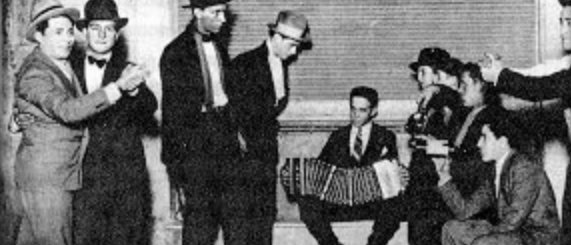 Tango began in the 1880s in the courtyards of conventillos (tenement houses) in the poorest, marginalized neighborhoods of Buenos Aires, Argentina and Montevideo, Uruguay, where homesick immigrants from Italy, Poland, Russia and Spain blended with local African and Indigenous populations. Known for expressing nostalgia, heartbreak, and longing stemming from its roots in immigrant culture, tango was rejected by high society, who viewed it as an immoral dance associated with crime, delinquency, and prostitution. By the early 1900s, however, it gained popularity and moved from the slums into the mainstream, and eventually spread to London, New York, and Paris.
Tango is a passionate courtship dance often described as a game of seduction, romance, and intimate connection. Key elements include a close embrace, precise walking steps with knees slightly bent and a low, grounded center of gravity, sharp and intricate leg movements, and dramatic and intense pauses. To mirror the close, sometimes aggressive, and dramatic connection between the partners, the music imitates the embrace, walking, and passion of the dance alternating between rhythmic sections with sharp, accented notes for abrupt movements and slow, melodic, and smooth phrases for fluid, sensual motion. The binary or quadruple meter is driven by the tango ensemble, consisting of piano, strings and bandoneón – an instrument similar to an accordion but with buttons rather than keys, developed in Germany around the 1850s by music dealer Heinrich Band.
Of all the featured tango composers in the program, it is important to draw attention to Astor Piazzolla (1921–1992), born in Mar del Plata, a coastal city about 248 miles from Buenos Aires and considered the world's foremost composer of tango. Among his several teachers was Alberto Ginastera, who gave him private lessons for five years in the early 1940s. Piazzolla’s greatest contribution was the creation of Nuevo Tango, a radical fusion that transformed traditional Argentinian tango from functional dance music into a sophisticated concert form by integrating jazz, academic techniques, and experimental harmonies. A virtuoso bandoneónist, he toured the world performing his own compositions with a variety of ensembles. “Ausencias” is a clear example of Nuevo Tango, moving away from danceable traditional tango toward a more classical and deeply emotional piece characterized by deep nostalgia, haunting melodies, and heartfelt longing. Piazzolla died in Buenos Aires two years after suffering a cerebral hemorrhage, which had left him in a coma. [Return to top of page]
Alberto Ginastera: Lamentations of the Prophet Jeremiah, Op. 14
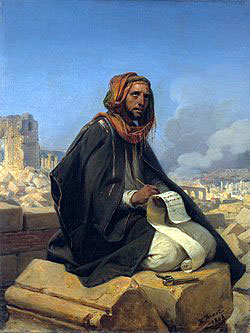 Ginastera composed the Lamentations in 1946 while in New York on a Fulbright grant and premiered the piece in Buenos Aires in 1947 with the Lagún Onak Chorus under the direction of Juan José Castro, an early mentor. The work is said to convey Ginastera’s response to the tragedies of World War II and the regime of Colonel Juan Perón, who rose to power following a 1943 military coup, but who transitioned to a dictatorial style of rule after becoming democratically elected in 1946. For a piece about tragic events, he chose texts from the Book of Lamentations, a collection of five anonymous poetic laments traditionally attributed to the prophet Jeremiah (c.627-c.580 BCE), detailing the destruction of Jerusalem in 586 BCE, one of the most devastating events in the Kingdom of Judah's history. After a siege of many months, Nebuchadnezzar II, king of the Neo-Babylonian Empire, entered Jerusalem, systematically destroyed it, razed the 400-year-old First Temple, and forced the royal family, the court, warriors, priests, and skilled craftsmen, around 20,000 people, into exile in Babylonia.
The composer structured the piece into three movements, O vos omnes, Ego vir videns and Recordare, Domine, drawn respectively from poems 1, 3 and 5 (of a total of 5). Ginastera set them for unaccompanied chorus, the only one of his three choral works to receive such treatment as Psalm 150, Op. 5 (1938) and Turbae ad Passionem Gregorianam, Op. 43 (1974) have instrumental accompaniment. As is typical in his musical language, Ginastera blends European and Argentinian elements. Like in many of his works, the Argentinian trait is the perfect fourth, dominating melody and harmony, derived from the “natural” tuning of the guitar – E-A-D-G-B-E – the favorite instrument of the gauchos, the inhabitants of the pampas, the vast, fertile, and largely flat grassland region covering over 25% of the country. The gauchos, admired as skilled horsemen and cattle herders, are symbols of national identity, rural tradition, and freedom, much like the American cowboy.
O vos omnes, setting verses 12, 16 and 20 of the first lamentation and 66 of the third in the order 12-20-16-66, is an emotionally intense piece to express a “sorrow unlike any other sorrow.” The tempo is Tragico e molto vivo, melodies are syllabic and somewhat disjointed, the rhythm is unrelenting, dissonance is used often, and dynamics are loud. Sopranos and altos introduce verse 12 with the cry “AH!” in divisi using a grace note in fortissimo, an expression of anguish and pain, while the tenors and basses sing “All you who pass by” with a melody using the ubiquitous perfect fourth. To attract the attention of passersby, Ginastera repeats a strident “look” (attendite) three times, twice by tenors and basses and once by the whole choir in subito fortissimo, with the voices singing in high ranges. To contrast with the entire chorus singing, “see if there is any sorrow like my sorrow” is set in a fugato at the perfect fifth, where the main theme is introduced by the basses and imitated by the other voices. The tension created by the fugato is followed by an intricate tutti for the Lord’s “fierce anger,” where sopranos and tenors at the octave are imitated by altos and basses also at the octave. Verse 20 and 16 follow a similar format, both start with imitation, which in verse 20 is a variation of the main theme and both end with a tutti. The tutti in verse 20 ends with altos and basses screaming the word “death,” with sopranos and tenors wailing a high A5, while in verse 16, the tutti obsessively repeats the “enemy that has prevailed” with the sopranos once more screaming a high A5. Verse 66 closes the piece, repeating “AH!” from the opening, but now in fortississimo tutta la forza, as Ginastera uses extreme dynamics and the voices in high ranges to increase the feeling of urgency, asking the Lord repeatedly to “pursue and destroy the enemy.”
A striking movement, Ego vir videns, sets verses 1, 2, 4, 6, 8 and 18 of the third lamentation, focusing on the poet’s feeling of being surrounded by “darkness without any light.” To express darkness, the tempo is now Grave, the dynamics are mostly piano or pianissimo, the sopranos are used sparingly, and the voices are kept in a low range. Fittingly, the opening words of verse 1 “I am the man who has seen affliction” are introduced by the basses singing a somber melody in piano with prominent perfect fourths and fifths in long rhythmic figures, including “longas,” a musical note used rarely in modern musical notation. In Verse 6, “He has made me dwell in darkness like the dead of long ago,” the tenor and bass repeat “darkness” to an ostinato, a musical phrase that repeats obsessively, with the perfect fourth dominating the basses’ line. The altos sing the words of verse 8, expressing the poet’s despondence as his calls and cries for help go unheeded by the Lord in a low, slow, and static melody over another ostinato by the tenors and basses repeating the word “dead.” Verse 18 begins with the poet’s words, “So I say,” sung by the basses alone using a “longa” on E2, a note so low that basses are hardly ever asked to sing it, anticipating the words “Gone is my glory, and my expectation from the Lord,” sung by the three lower voices in a long and mournful melody depicting a disconsolate poet whose suffering is so intense he feels abandoned by the Lord.
In the concluding movement, Recordare Domino, Ginastera uses verses 1, 19 and 21 from the fifth lamentation, in the order 1-21-19. He uses a fugato with prominent perfect fourths for verse 1, urging the Lord to remember “what has befallen us.” If the previous verse emphasizes the word “remember,” verse 21 stresses “restore us,” as the poet asks the Lord to return the Israeli community to the “days as of old.” The melodies are not as angular as in the previous movements, but are more soothing and are presented in different textures, sometimes in imitation, other times in homorhythm or in more intricate counterpoint building up to a tutti in fortissimo for “restore us, Lord.” Ginastera chooses to conclude with verse 19. The tempo is now allegro, the meter is binary, and the main theme of this fugato is joyful, as the poet’s faith in the Lord has been restored. To reinforce the everlasting power of the Lord, the word “generations” (generationem) is repeated countless times. The piece closes with all voices singing “Lord” in fortississimo with altos and basses divided. [Return to top of page]
Martín Palmeri: Misa a Buenos Aires (Misatango)
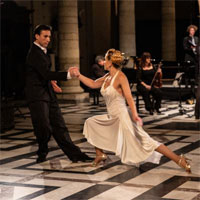 Palmeri completed Misatango, his best-known work, in April 1996. Scored for mezzo-soprano, mixed chorus, and a typical tango ensemble of bandoneón, piano and strings, the first performance was given on August 17, 1996, at Teatro Broadway in Buenos Aires performed by the National Symphony Orchestra of Cuba with the choirs of the Law Faculty of the University of Buenos Aires and of the Vicente López municipality. Palmeri, a renowned choir conductor, dedicated the Mass to both choirs, as his work conducting them inspired its composition. “At the beginning of my career in Buenos Aires, I worked as a choir conductor and, at the same time, as a pianist and director of a tango orchestra. Many singers from my choir loved the tango and came very often to see our concerts with the tango orchestra. So, it was natural to start thinking of a project we could do together. After some experiments with no good results from traditional tangos, I decided, rather than arrangements, it would be better to compose original music for choir and tango orchestra. And that was the beginning of Misa a Buenos Aires.”
The work follows the traditional Latin Mass: Kyrie, Gloria, Credo, Sanctus, and Agnus Dei, a deliberate decision by Palmeri, as he says it reflects “the place of the Latin language among centuries of choral music and the universal connection to the language. But [it] also … gives the work a reserved, esoteric quality which, from my point of view, has much to do with tango.” These prayers, known as the Ordinary of the Mass, date back to the 7th century or earlier and are the foundational components of the Catholic Mass, as their fixed and unchanging texts are repeated daily, providing a stable structure that allows Catholics to participate in the same worship, regardless of location or time.
Palmeri opens the Kyrie with the distinct, syncopated rhythm of tango. The first statement of “Lord have mercy” is sung by all the voices in fortissimo and in homorhythm. After an instrumental interlude featuring intense bandoneón lines, Palmeri, a follower of Nuevo Tango, uses a fugato for further statements of the text. The subject displays the precise, crisp articulation of tango, while the melody expresses the text’s pleas for mercy. The soaring melodic lines of the “Christ have mercy” serve as a lyrical contrast to the fugal Kyrie. A luscious instrumental interlude anticipates the next fugato for the last “Lord have mercy,” which ends with the return of the opening fugato but with increased intensity. Following the Kyrie, the Gloria opens with an exuberant syncopated melody of praise for “Glory to God in the highest.” A slower, darker, and melancholic melody sung by the soloist asks for mercy, a plea reinforced by the choir offering a deep sense of devotion. The faster tempo and the enthusiastic melodies of the opening return to close the movement with an affirming repetition of “amen.”
For the Credo, a confession of faith outlining the four core tenets of Catholic doctrine – one God, one Lord Jesus Christ, the Holy Spirit, and one Church – Palmeri follows the tradition of dividing the long text into smaller sections. He begins with the voices in unison to ensure text clarity for “I believe in one God.” Similarly, “I believe in one Lord Jesus Christ” is set syllabically and in homorhythm. As is customary, “he came down from heaven” is set to descending melodies. Palmeri also follows tradition by featuring the soloist with a passionate melody in a slower tempo, creating drama for “was incarnate” and “became man,” the holiest moment of the text. The drama continues with the chorus depicting agony by entering in imitation, layering upon one another to create a dense, somber texture for “was crucified.” Traditional word painting is again used for “was buried,” as it is set to descending melodies. The original tempo returns to celebrate “rose again on the third day,” set to a fugato. For the last two tenets, Palmeri has the soloist sing “I believe in the Holy Spirit” and the male voices “I believe in one, holy, catholic and apostolic Church.” Palmeri, however, superimposes the female voices to restate “I believe in one God, the Father almighty.”
Providing contrast with the previous movements, the Sanctus has an instrumental introduction: a piano rubato, characterized by rhythmic flexibility. Palmeri also has the solo enter before the chorus with an expressive melody for “Holy Lord God of hosts.” The chorus follows with variations on this beautiful melody, but for “Heaven and earth,” the composer uses the voices in imitation. For the Benedictus, Palmeri has the three upper voices singing a solemn melody of repeated notes in long rhythmic values for “Blessed,” but “He who comes in the name of the Lord” is set in imitation featuring text repetition. The Agnus Dei follows a similar format. It opens with the bandoneón, playing the melancholic melodies of tango, followed by the soloist singing a moving melody for “Lamb of God.” Palmeri closes the movement and the Mass with material from the Kyrie’s opening fugato for “grant us peace,” but using the material in imitation to generate an extended section focusing on the hope for peace, a common feature in Mass settings today, when composers emphasize the plea for peace in response to the global conflicts being experienced in our turbulent world. [Return to top of page]
Alberto Ginastera (1916–1983)
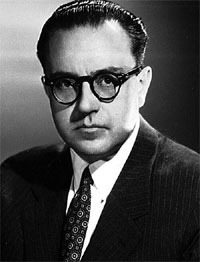 The first Argentinian academic composer to achieve international fame, Ginastera was born in Buenos Aires to parents of Catalan and Italian descent. After graduating in 1938 with a degree in composition from the Conservatorio Nacional de Música, he spent most of his professional life mentoring a generation of composers not only from Argentina, but from all over South America at institutions like the Liceo Militar General San Martín, the Conservatorio Nacional, the Universidad Católica Argentina, and the Instituto Torcuato di Tella.
A prolific composer, Ginastera began writing music in 1930. Like other twentieth-century composers, he drew heavily on folk elements. His ballet Panambí, Op. 1 (1937), where he uses Argentinian dances, gained him not only national but also international attention. Panambí was followed by Estancia, Op. 8 (1941), depicting life on the Argentinian pampas and commissioned by impresario Lincoln Kirstein for his company Ballet Caravan. Besides his two ballets, Ginastera wrote several orchestral works, including concertos for violin, cello, harp, and piano, numerous chamber pieces, four operas, various film scores and five song collections, mostly for solo voice and piano. In September 1971, he moved to Geneva to escape the oppressive political climate of Argentina’s military dictatorships, where he devoted himself entirely to composition. He passed away in Geneva at the age of 67. [Return to top of page]
Martín Palmeri (b. 1965)
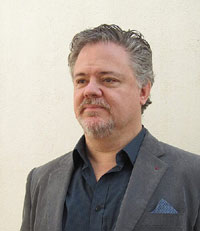 A composer, conductor, and pianist, Palmeri was born in Buenos Aires in 1965, where he began his formal musical studies at the age of 14. Concentrating on composition, choral conducting, and orchestration, his training took place under individual instructors rather than at a conservatory program. He gained international attention when his Misatango was performed in Rome in 2013 to honor the recently appointed Pope Francis, the former Cardinal of Buenos Aires, known for his love of tango. Besides the Mass, Palmeri has composed numerous vocal and instrumental works, including operas, oratorios, choral and orchestral compositions inspired by Nuevo Tango. A composer and conductor in great demand, Palmeri travels the world playing piano for his own compositions in performances worldwide. He states, however, that if he did not compose or make music, “I would be watching movies and traveling with my family around Patagonia in Argentina.” [Return to top of page]